🔒 Executive Clinical Takeaways
- Asymptomatic Majority: Clinical epidemiological data from the CDC and Florida Department of Health show that up to 70%–80% of Chlamydia, Gonorrhea, Trichomoniasis, and early HIV cases produce zero noticeable symptoms while remaining transmissible.
- Precision Window Timing: Testing too early after an exposure can cause a false-negative result. Fourth-generation HIV-1/2 Antigen/Antibody (p24) assays narrow the detection window to just 14–18 days, while urine NAAT detects bacterial STIs in 7–14 days.
- Zero Insurance EOB Footprint: By electing direct self-pay testing at UR Next Lab Service Solutions in Jacksonville, FL, your visit and results are never transmitted to health insurance carriers, employers, or shared policy Explanation of Benefits (EOB) statements.
1. Destigmatizing Sexual Health: Why Routine Screening Is Essential Healthcare
Taking charge of your sexual health should feel no different than checking your cholesterol or blood pressure. Yet across Northeast Florida, thousands of adults delay essential sexually transmitted infection (STI) and HIV screening out of embarrassment, fear of judgmental waiting rooms, or worry that a test code will appear on a shared family health insurance statement.
At UR Next Lab and Services Solutions, LLC (6015 Chester Cir Ste 108, Jacksonville, FL 32217), our clinical facility was purposefully designed around three core commitments: judgment-free compassion, CLIA-certified diagnostic accuracy (#10D2347904), and airtight patient confidentiality. Whether you are starting a new relationship, seeking peace of mind after a potential exposure, completing routine annual preventative screening, or monitoring PrEP therapy, understanding how modern STI assays work empowers you to test at the right time with complete confidence.

2. The Silent Epidemic: Why "Feeling Fine" Is Never a Substitute for Lab Testing
One of the most pervasive myths in public health is the belief that a sexually transmitted infection will immediately announce itself through pain, discharge, or visible lesions. In clinical reality, the human urogenital and mucosal immune systems frequently harbor bacterial, viral, and protozoal pathogens without triggering acute pain receptors:
- Chlamydia trachomatis: Roughly 75% of women and 50% of men with urogenital chlamydia experience no symptoms whatsoever. Left untreated, silent chlamydial cervicitis can ascend into the upper reproductive tract, causing pelvic inflammatory disease (PID), tubal scarring, and ectopic pregnancy.
- Neisseria gonorrhoeae: Over half of female gonococcal infections and the vast majority of pharyngeal (throat) and rectal infections remain completely asymptomatic, acting as silent reservoirs of transmission.
- Herpes Simplex Virus (HSV-1 & HSV-2): Up to 85% of individuals seropositive for HSV-2 have never recognized a classic herpetic blister, often mistaking mild skin irritation for an ingrown hair or razor burn.
- Early HIV-1 / HIV-2 Infection: Following initial transmission, many individuals experience either no symptoms or a brief, non-specific viral syndrome (mild fever, sore throat, or fatigue lasting 5–7 days) that is easily dismissed as a seasonal cold or flu.
3. The Science of Diagnostic Window Periods: Why Timing Matters
Every diagnostic laboratory assay searches for one of two biological targets: either the pathogen itself (its DNA, RNA, or surface structural proteins/antigens) or your immune system's antibody response (IgM and IgG immunoglobulins) generated against that pathogen.
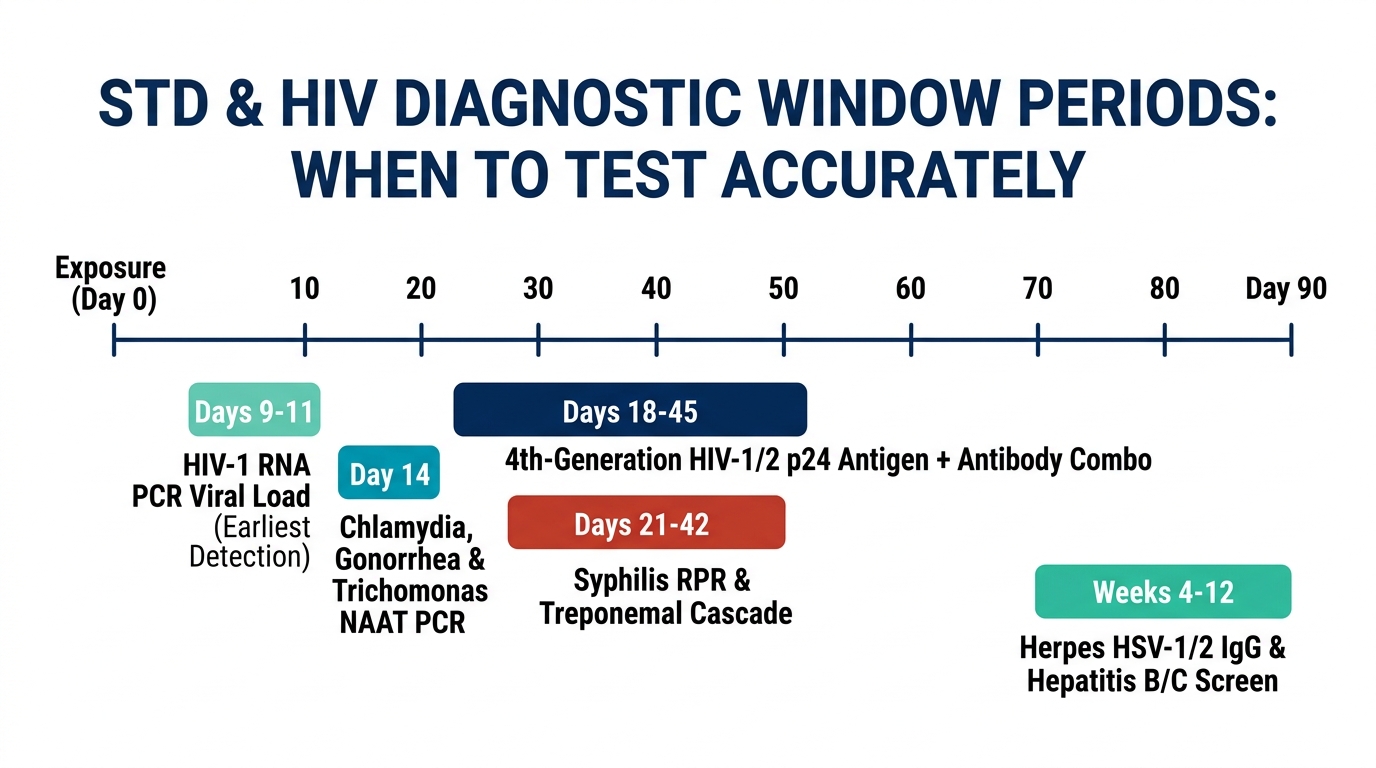
The interval between the moment of potential exposure and the moment a diagnostic test can reliably detect the infection is called the Window Period. If you test 24 hours after an encounter, bacteria have not yet replicated to detectable colony densities on mucosal surfaces, and your B-lymphocytes have not yet synthesized antibodies. Knowing which assay targets DNA/antigens versus antibodies allows our clinicians to guide you to the right test—or schedule a confirmatory follow-up screen—so you never rely on a premature false negative.
4. 4th-Generation HIV-1/2 Antigen/Antibody (p24) vs. Rapid Point-of-Care Screening
Not all HIV tests are created equal. Older 3rd-generation antibody-only tests required patients to wait 6 to 12 weeks for seroconversion. At UR Next Lab, we offer both rapid Point-of-Care screening and gold-standard 4th-Generation HIV-1/2 Antigen/Antibody Combination Assays:
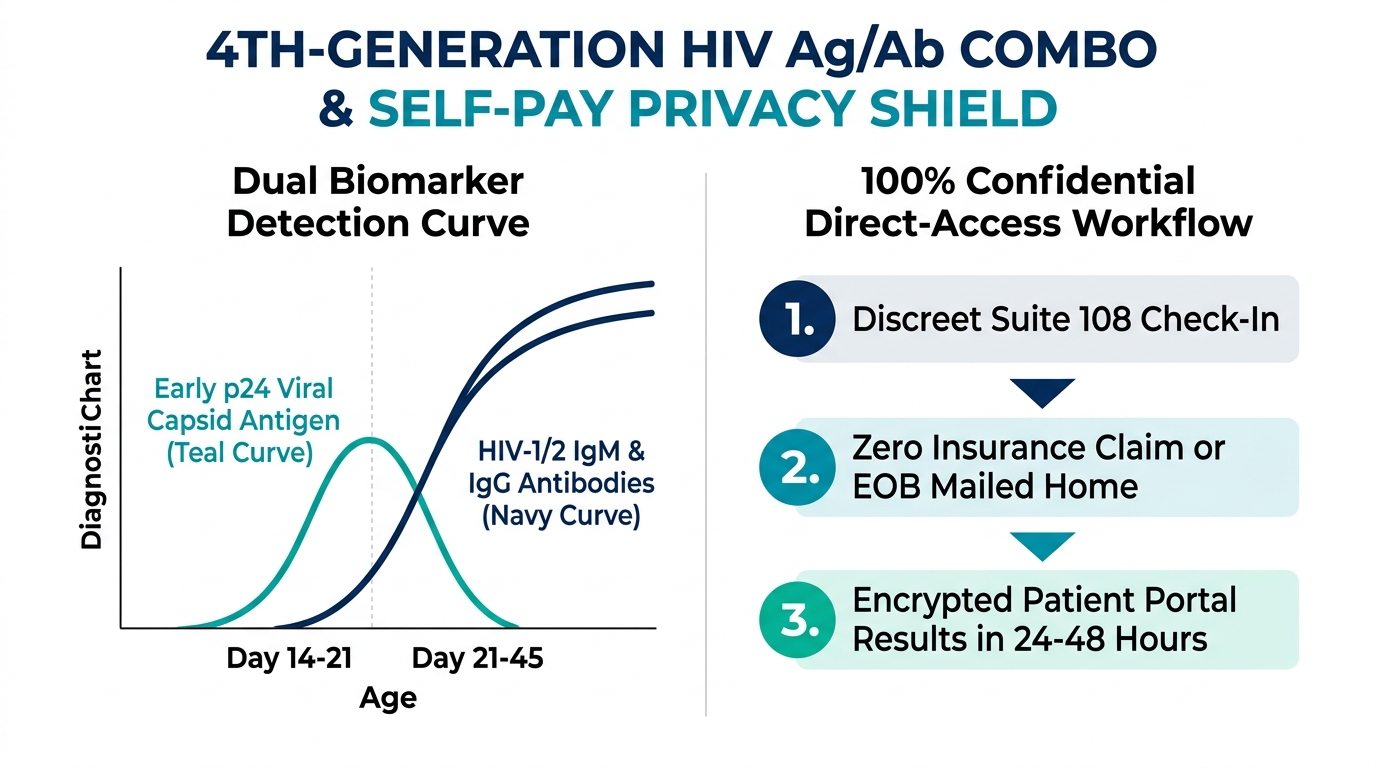
- How 4th-Generation HIV Testing Works: Simultaneously screens venous blood for both host antibodies (directed against HIV-1 and HIV-2) and the HIV-1 p24 capsid antigen—a viral core protein that surges in the bloodstream just 14 to 18 days after exposure, weeks before antibodies appear. By day 28 to 45 post-exposure, 4th-generation venous lab testing achieves >99.7% clinical sensitivity and specificity.
- Rapid 15-Minute Point-of-Care HIV Screening: Ideal for immediate baseline peace of mind during walk-in visits, providing preliminary results before you leave the clinic.

5. First-Catch Urine NAAT PCR: Painless, Swab-Free Testing for Chlamydia, Gonorrhea & Trichomoniasis
Gone are the days when male or female patients had to endure uncomfortable urethral swabs for routine bacterial STI testing. Modern molecular diagnostics utilize Nucleic Acid Amplification Testing (NAAT)—a PCR-grade technology that amplifies microscopic fragments of bacterial or protozoal DNA/rRNA by millions of copies.
Using a simple, painless first-catch urine cup (collecting the very first 20–30 mL of your urine stream after holding urine for at least 1 to 2 hours), NAAT detects Chlamydia trachomatis, Neisseria gonorrhoeae, Trichomonas vaginalis, and Mycoplasma genitalium with sensitivity exceeding 99%—matching or surpassing invasive clinician-collected swabs.
6. Syphilis (RPR / Treponemal) & Type-Specific Herpes (HSV-1 & HSV-2 IgG)
A truly comprehensive sexual health panel goes beyond urine testing by evaluating bloodborne spirochetes and latent viral antibodies:
- Syphilis RPR (Rapid Plasma Reagin) with Reflex Confirmation: Screens serum for non-treponemal reagin antibodies produced in response to Treponema pallidum infection. Because syphilis rates have risen sharply across Florida in recent years—and because a primary painless chancre heals on its own even as the bacteria remain active—routine blood screening is essential.
- Herpes Simplex Virus Type-Specific Glycoprotein G (IgG) Testing: Older non-specific tests could not distinguish between common childhood cold sores (HSV-1) and genital herpes (HSV-2). Our type-specific IgG immunoassay targets glycoprotein G-1 and G-2 separately, clearly differentiating HSV-1 from HSV-2 status.
7. Viral Hepatitis B (HBsAg) & Hepatitis C (HCV Antibody) Screening
The CDC now recommends universal screening for both Hepatitis B Surface Antigen (HBsAg) and Hepatitis C Antibody (Anti-HCV) for all adults at least once in their lifetime, and periodically for anyone with new sexual partners. Hepatitis B and C target liver tissue silently; early detection allows immediate curative antiviral therapy for Hepatitis C and protective management for Hepatitis B.
8. Master Pathogen Window Period & Specimen Reference Table
| Pathogen / Diagnostic Assay | Specimen Required | Early Detection Window | Conclusive Window | Turnaround Time |
|---|---|---|---|---|
| HIV-1/2 Ag/Ab (4th Generation p24) | Venous Blood / Fingerstick | 14–18 Days Post-Exposure | 45 Days Post-Exposure | 15 Mins (Rapid) / 24 Hrs |
| Chlamydia & Gonorrhea (NAAT PCR) | First-Catch Urine (Hold 1–2 Hrs) | 5–7 Days Post-Exposure | 14 Days Post-Exposure | 24–48 Hours |
| Trichomoniasis (NAAT / Rapid) | First-Catch Urine / Swab | 7 Days Post-Exposure | 14–21 Days Post-Exposure | Same-Day / 24–48 Hrs |
| Syphilis (RPR / Treponemal Screen) | Venous Blood Serum | 21 Days Post-Exposure | 6–12 Weeks Post-Exposure | 24–48 Hours |
| Herpes Simplex 1 & 2 (Type-Specific IgG) | Venous Blood Serum | 3–4 Weeks Post-Exposure | 12 Weeks Post-Exposure | 24–48 Hours |
| Hepatitis B (HBsAg) & Hepatitis C (Ab) | Venous Blood Serum | 3–4 Weeks (HBV) / 4–6 Wks (HCV) | 8–12 Weeks Post-Exposure | 24–48 Hours |
9. Your Legal Right to 100% Privacy: HIPAA & the Florida Omnibus AIDS Act
When you use health insurance to pay for an STD or HIV panel at a conventional clinic, the laboratory is contractually required to transmit ICD-10 diagnosis codes and CPT test descriptions to your insurance company. Your insurer then mails or posts an itemized Explanation of Benefits (EOB) to the primary policyholder—which can inadvertently disclose sensitive testing to a spouse, parent, or employer plan administrator.
At UR Next Lab Service Solutions, we protect your privacy under both the federal HIPAA Privacy Rule (45 CFR § 164.522) and the Florida Omnibus AIDS Act (Section 381.004, Florida Statutes). When you choose our affordable direct self-pay individual tests or our 10-Test Comprehensive STD & HIV Peace-of-Mind Panel, your visit is never billed to insurance, never appears on an EOB, and is delivered exclusively to you via encrypted digital report or in-person clinic pickup.
10. What to Expect During Your Discrete 15-Minute Walk-In Visit
- Walk In or Pre-Book Online: Visit 6015 Chester Cir Ste 108, Jacksonville, FL 32217 Monday through Friday (8:00 AM – 6:00 PM, closed 12–1 PM for lunch). No doctor's referral is needed.
- Private Check-In: Our discrete reception area respects your personal space. Simply present your photo ID and select either a targeted single test or our Complete STD/HIV Panel.
- Quick 5-Minute Collection: Provide a small first-catch urine sample in a private restroom and/or a quick venous blood draw by our gentle certified phlebotomist.
- Confidential Digital Results: Receive rapid results in 15 minutes or full reference molecular panel results within 24–48 hours directly to your private encrypted email.
Need Confidential Peace of Mind Today?
Walk into our Southside Jacksonville lab with zero appointment required, or reserve a private time slot online in 30 seconds.